Best Crispy Chicken Alfredo Recipe (With Food Science Secrets)
By Chef John | Easy Recipes & Smart Cooking Hacks
The Crunch That Changes Everything
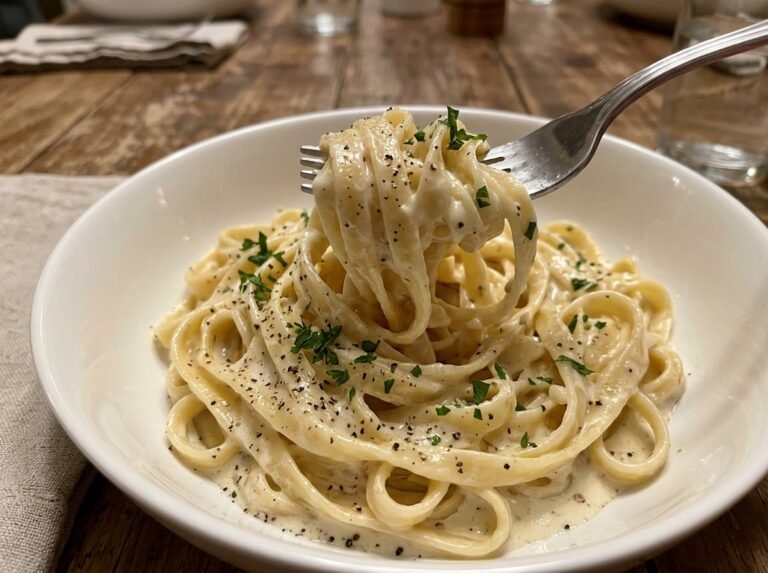
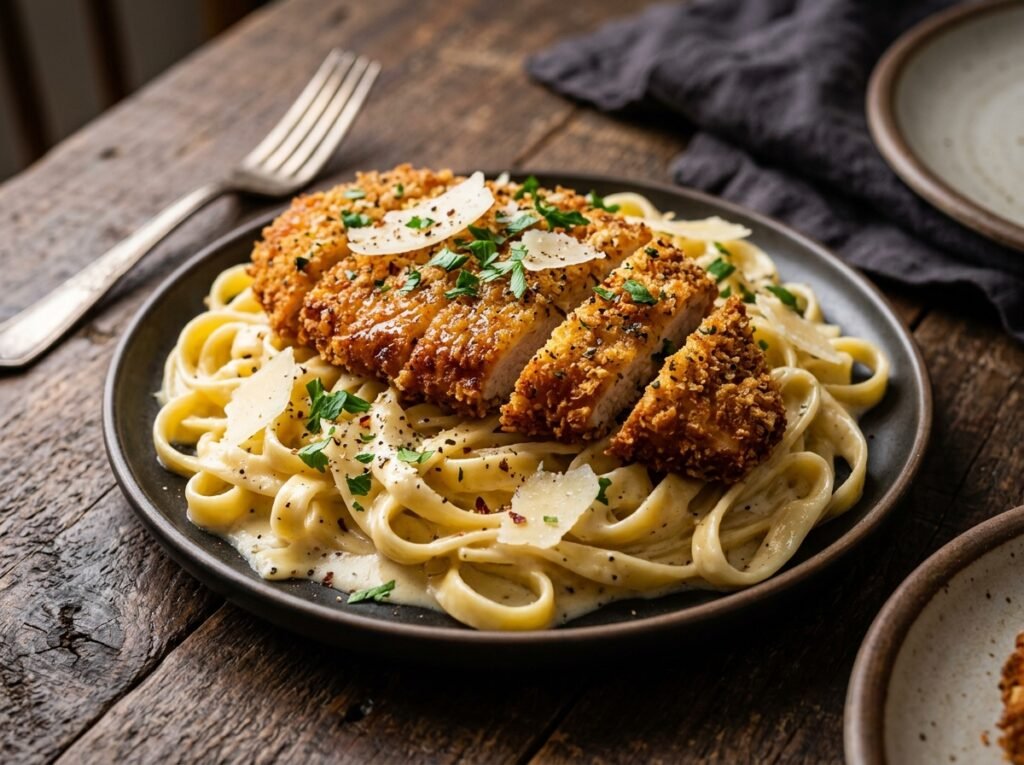
Close your eyes for a second. Imagine the sound of a golden chicken cutlet hitting a plate — that satisfying, crackling snap — followed immediately by the silkiest, creamiest garlic sauce you have ever pulled across a nest of fettuccine. That contrast. That tension between crunch and cream. That is exactly what the best crispy chicken alfredo recipe is supposed to feel like, and most home cooks never quite get there.
I have tested this method across dozens of batches, adjusting the oil temperature and cheese ratios to isolate exactly what makes the difference. And I can tell you right now — the gap between a good chicken alfredo and an unforgettable one comes down to three specific moments in the process. Not fancy equipment. Not impossible ingredients. Just understanding what is actually happening inside your pan.
This is not the recipe you throw together on a Tuesday and forget by Friday. This is the one your family asks for by name.
The Food Science Behind Crispy Chicken Alfredo
Let’s talk about why this dish works when you do it right — and falls apart when you don’t.
Protein denaturation is the first thing to understand. When chicken breast hits heat above 140°F / 60°C, its muscle proteins begin to unfold and contract. Push past 165°F / 74°C without a buffer — meaning a proper breading or rest period — and those proteins squeeze out moisture like a sponge, leaving you with dry, chalky meat. The crust is not just about texture. It acts as a physical moisture barrier, slowing evaporation and keeping the inside tender while the outside turns deeply golden.
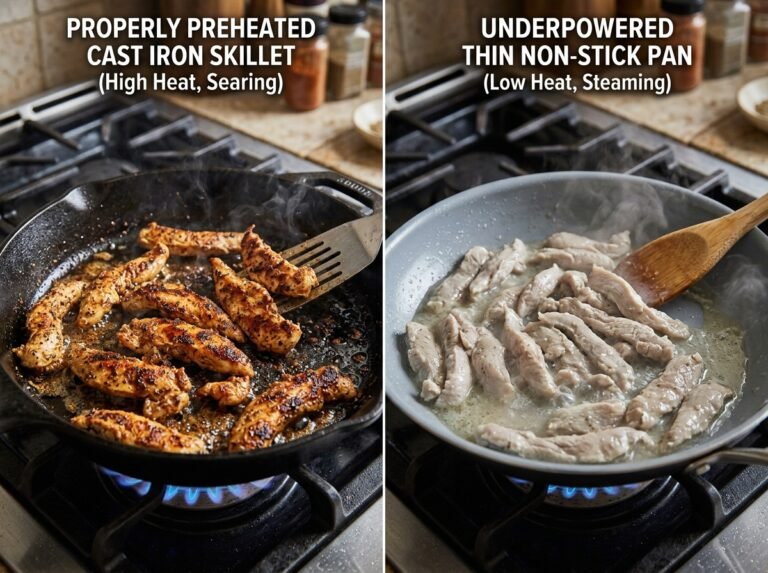
The Maillard reaction is responsible for that irresistible, nutty, brown crust. It kicks in around 280–330°F / 138–165°C at the surface of the breading when amino acids and reducing sugars collide under high, dry heat. This is why the oil temperature matters so much. Too cool and you get pale, greasy chicken. Too hot and the crust burns before the center cooks through.
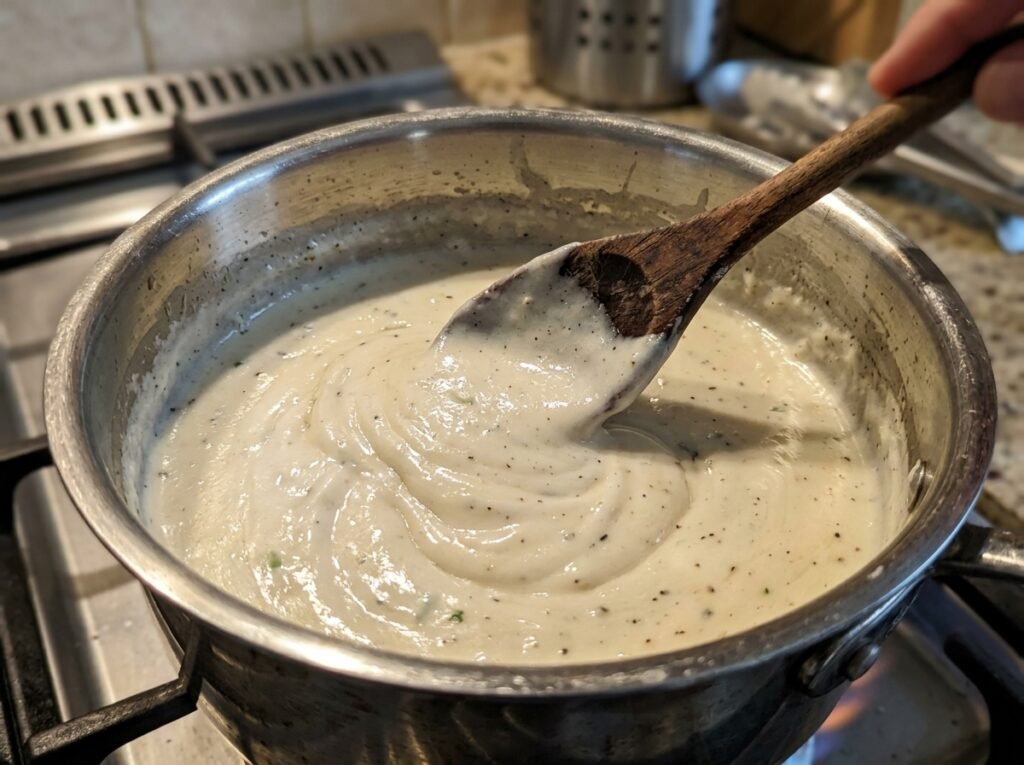
Then there is the sauce — and this is where most people lose the dish entirely. Emulsification is the process of suspending fat droplets evenly inside a water-based liquid using a bridging agent. In alfredo sauce, that bridging agent is the casein protein in Parmigiano-Reggiano and the phospholipids in heavy cream.
Fat Drops+Casein Protein→Stable Emulsion
In simple terms: if your cream gets too hot, the proteins denature and the fat separates out into a greasy pool. Keep the heat gentle and patient, and everything stays velvety and bound together.
Pro Buying Guide — What to Actually Buy in the USA
This is where the recipe either wins or gets sabotaged at the grocery store. Let me be direct with you.
For the cheese, buy a wedge of real Parmigiano-Reggiano — look for the dotted rind that reads “Parmigiano-Reggiano” around the edge. You can find it at Whole Foods, Trader Joe’s, and most Kroger stores near the specialty cheese section. The pre-grated stuff in the green shaker bottle contains cellulose powder, which actively prevents proper melting and will cause your sauce to turn grainy. This is non-negotiable.
For the butter, Kerrygold is my first recommendation every time. It is widely available at Walmart, Target, and Trader Joe’s, and its higher butterfat content (82% vs the American standard of 80%) produces a noticeably richer, more stable sauce base.
For the pasta, reach for De Cecco fettuccine or Barilla fettuccine — both bronze-die extruded options that have a slightly rougher surface, which grips the sauce instead of letting it slide off. You will find both at virtually every Kroger, Walmart, or Whole Foods in the country.
For the chicken, choose boneless, skinless chicken breasts that are uniform in thickness — or butterfly them yourself. Fresh over frozen here makes a real difference in the final crust adhesion. Look for air-chilled options at Whole Foods for the best moisture retention.
Ingredients
| Category | Ingredient | US Customary | Metric |
|---|---|---|---|
| The Chicken | Boneless, skinless chicken breast | 2 large breasts | ~600g |
| Kosher salt | 1 tsp | 5g | |
| Black pepper | ½ tsp | 2g | |
| Garlic powder | ½ tsp | 2g | |
| The Crust | All-purpose flour | ½ cup | 60g |
| Large eggs | 2 | 2 | |
| Italian breadcrumbs | 1 cup | 110g | |
| Grated Parmigiano-Reggiano (for crust) | ¼ cup | 25g | |
| Neutral oil (vegetable or avocado) | ½ cup | 120ml | |
| The Alfredo Sauce | Kerrygold unsalted butter | 4 tbsp | 57g |
| Garlic cloves, minced | 4 cloves | 4 cloves | |
| Heavy cream | 1½ cups | 360ml | |
| Parmigiano-Reggiano, freshly grated | 1½ cups | 150g | |
| Salt and white pepper | To taste | To taste | |
| The Pasta | De Cecco or Barilla fettuccine | 12 oz | 340g |
| Reserved pasta water | ½ cup | 120ml |
Common Mistakes Table — Why Most People Fail This Recipe
| The Mistake | What Actually Happens | The Fix |
|---|---|---|
| Using pre-shredded cheese with cellulose | Cellulose coating blocks melting, creating a grainy, clumpy sauce | Always grate from a fresh wedge right before cooking |
| Boiling the cream sauce | Proteins over-denature, fat splits out, sauce turns greasy | Keep heat at medium-low; never let it reach a full boil |
| Crowding the chicken in the pan | Steam builds up, the Maillard reaction stalls, you get pale, soft crust | Cook in a single layer with space — fry in two batches if needed |
| Skipping the pound/flatten step | Uneven thickness means the outside overcooks before the center reaches 165°F | Butterfly or pound to ½ inch / 1.3cm uniform thickness |
| Adding cold cheese to hot cream | Rapid temperature shock causes proteins to seize and clump | Let cream cool slightly below a simmer before adding cheese in stages |
| Not salting the pasta water | Pasta tastes flat and bland, even in a rich sauce | Salt generously — the water should “taste like the sea” |
Step-by-Step Method
Prepare and Flatten the Chicken
Start by placing your chicken breasts between two sheets of plastic wrap or inside a zip-lock bag. Using a meat mallet or rolling pin, pound them to an even ½ inch / 1.3cm thickness. This single step is one of the most important things you will do today — uniform thickness means even cooking and a crust that finishes at exactly the same moment as the interior hits a safe temperature.
Season generously on both sides with kosher salt, black pepper, and garlic powder. Let them sit at room temperature for 10 minutes while you set up your breading station. That brief rest allows the salt to begin pulling moisture to the surface, which actually helps the flour adhere better.
Build the Breading Station
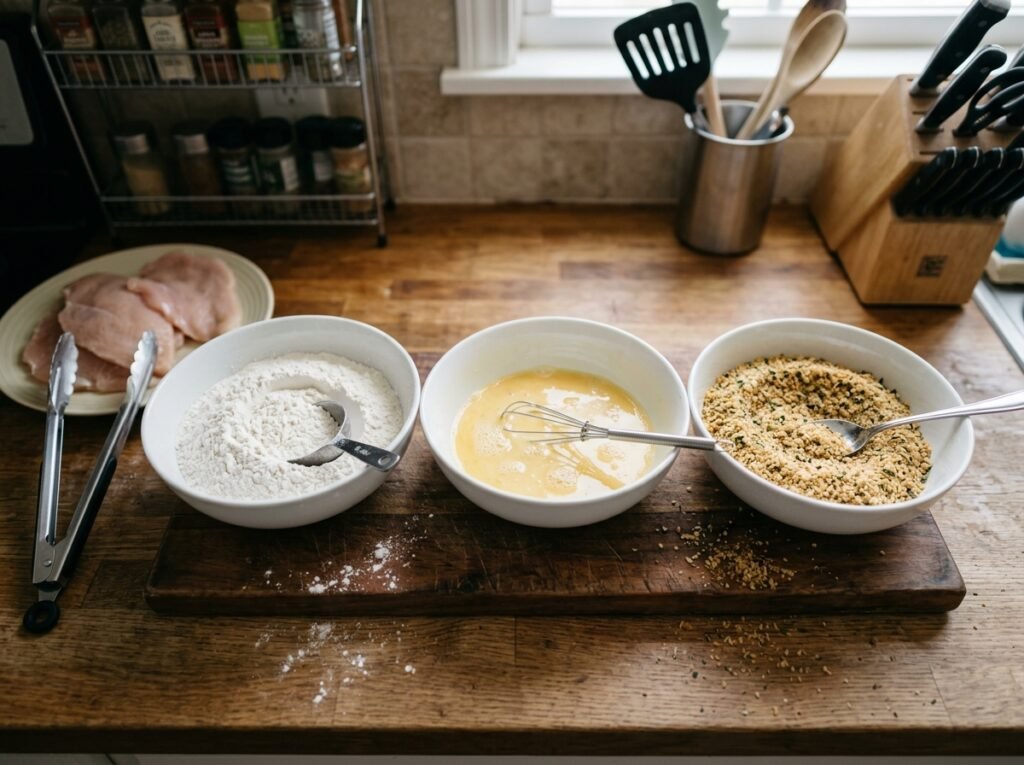
Set up three shallow bowls in a line. The first holds your all-purpose flour. The second holds your beaten eggs. The third combines the Italian breadcrumbs with the quarter cup of grated Parmigiano-Reggiano — mixing cheese directly into the crust layer adds an extra dimension of flavor and contributes to a deeper golden color during frying.
Coat each cutlet in flour first, pressing lightly to remove any excess. Then drag it through the egg wash, letting the excess drip off. Finally, press firmly into the breadcrumb mixture on both sides. That firm press matters — loose crumbs detach in the oil and burn.
Fry the Chicken to Perfect Golden Crunch
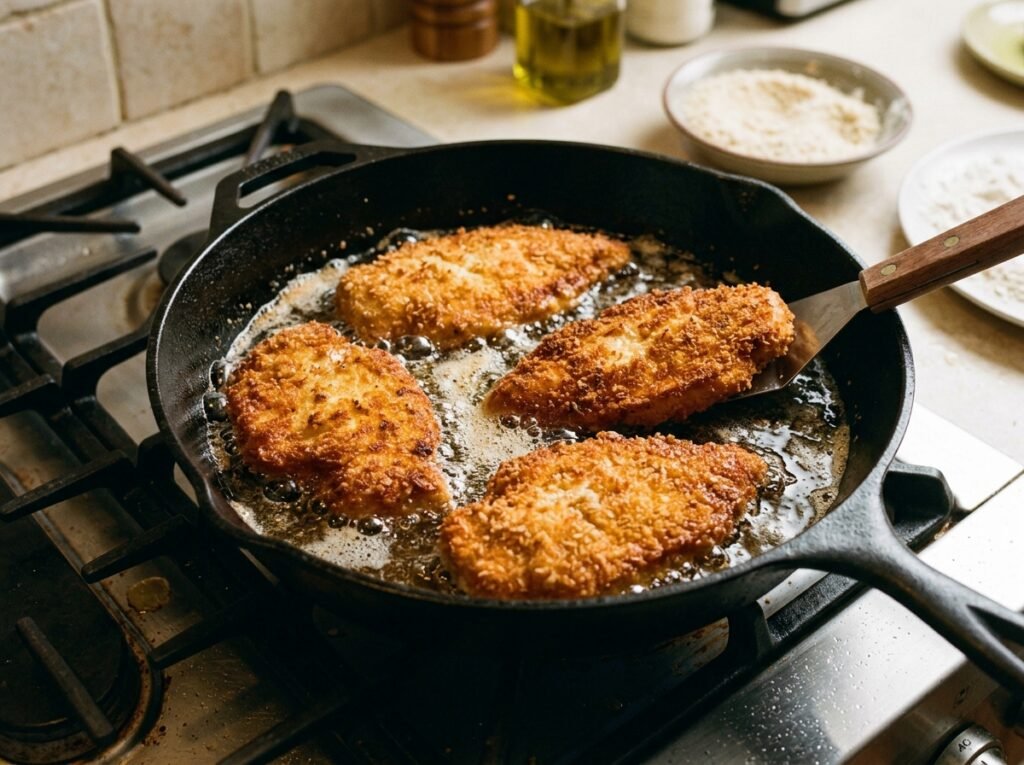
Heat your neutral oil in a large, heavy-bottomed skillet — cast iron or stainless steel — over medium-high heat until it reaches approximately 350°F / 177°C. If you do not have a thermometer, drop a small pinch of breadcrumbs into the oil. If they sizzle and float immediately, you are ready.
Lay the breaded cutlets gently away from you into the oil. You should hear a confident, steady sizzle from the moment they hit the pan. Cook undisturbed for 4–5 minutes per side until deeply golden. Resist every urge to move or press them. The crust needs continuous, uninterrupted contact with the hot oil to complete the Maillard reaction fully. Transfer to a wire rack — never a paper towel flat — so the bottom stays as crispy as the top.
Cook the Fettuccine
While the chicken rests, bring a large pot of generously salted water to a boil. Cook your fettuccine according to the package directions until just al dente — that slight resistance at the center means the pasta will continue cooking briefly when it meets the warm sauce. Before draining, scoop out half a cup / 120ml of that starchy pasta water and set it aside. It is liquid gold for adjusting your sauce later.
Build the Cream Sauce Low and Slow
In a wide sauté pan over medium-low heat, melt the Kerrygold butter until it begins to foam lightly. Add the minced garlic and stir constantly for about 60 seconds — long enough to bloom the aromatic compounds without browning. Pour in the heavy cream and bring it to a very gentle simmer, not a boil. You want to see lazy, slow bubbles at the edges — that is the sweet spot for emulsification.
Remove the pan from heat for 30 seconds before you begin adding the Parmigiano-Reggiano in small handfuls, stirring in a steady circular motion after each addition. The slight temperature drop before adding the cheese is what prevents the sauce from breaking. Once all the cheese is incorporated and the sauce coats the back of a spoon, taste and adjust salt and white pepper.
Bring Everything Together
Add the drained fettuccine directly into the sauce pan and toss over low heat for 60–90 seconds. If the sauce feels too thick, add a splash of that reserved pasta water — the starch acts as a secondary emulsifier and loosens the texture without watering down the flavor.
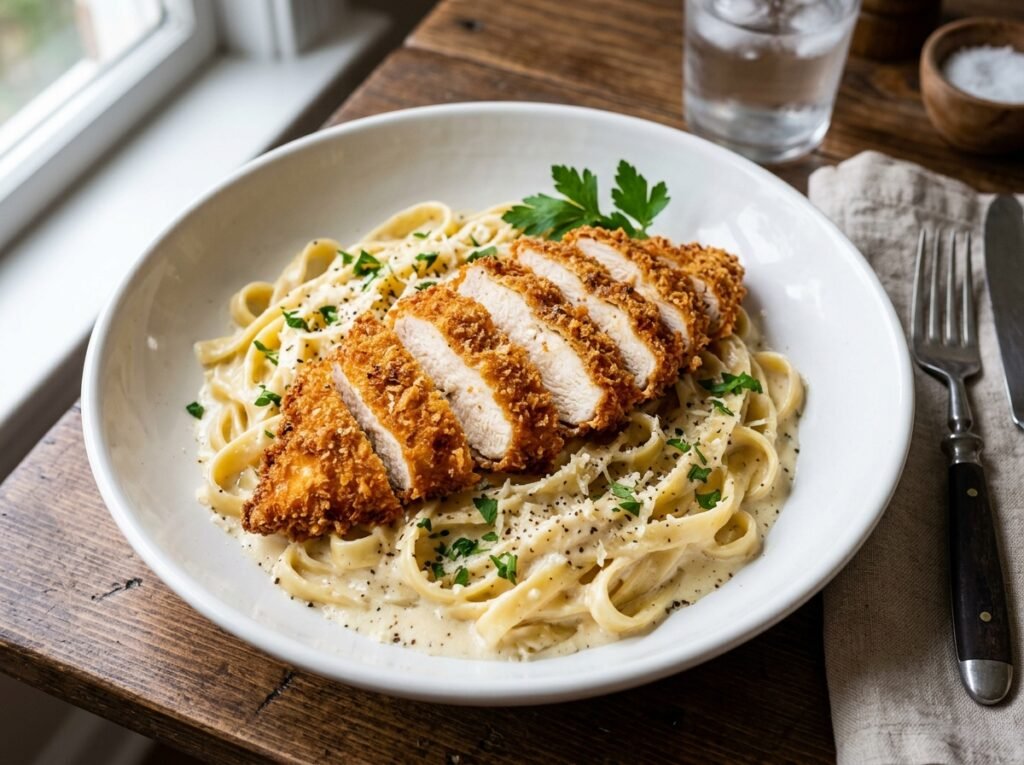
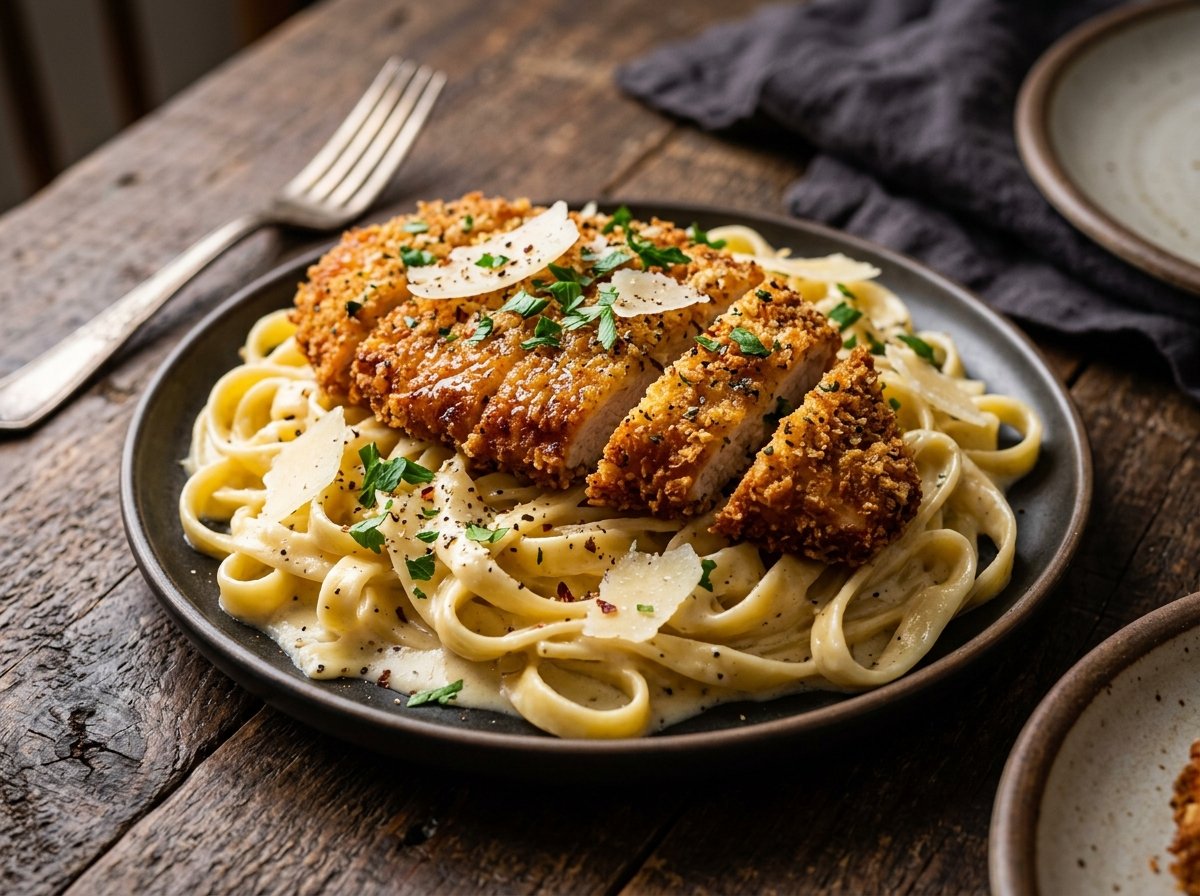
Slice the crispy chicken on a bias and lay it across the top of the plated pasta rather than mixing it into the sauce. This preserves the crust completely. Finish with a fresh snowfall of hand-grated Parmigiano and a few turns of black pepper.

Best Crispy Chicken Alfredo Recipe (With Food Science Secrets)
Ingredients
Equipment
Method
- Place the chicken breasts between plastic wrap and use a meat mallet to pound them to an even 0.25-inch thickness. This ensures uniform protein denaturation so the chicken cooks evenly without drying out.
- Set up a three-dish dredging station: Dish one has seasoned flour, dish two has beaten eggs, and dish three has a mix of panko breadcrumbs and grated Parmigiano-Reggiano.
- Coat each cutlet in flour (shake off excess), dip completely into the egg wash, and press firmly into the panko-parmesan mixture until fully crusted.
- Heat your cast iron skillet over medium-high heat and add the oil until it reaches 350°F (177°C). Fry the chicken cutlets for 3 to 4 minutes per side until the crust triggers the Maillard reaction, turning deeply golden brown.
- Remove the chicken and place it on a wire cooling rack set over a baking sheet (do not use paper towels, or the trapped steam will make the bottom soggy). Ensure the internal temperature reads 165°F (74°C).
- Section 3: Boiled to Al Dente
- Drop the fettuccine into a large stockpot of boiling salted water. Cook for 9 to 10 minutes, or 1 minute less than the package instructions, so the starch network can finish cooking directly inside the sauce later.
- Reserve 1 cup (240ml) of cloudy, starchy pasta water before draining the noodles. This starch is crucial for your sauce structure.
- In a heavy-bottomed sauté pan over medium-low heat, melt the Kerrygold butter. Add the minced garlic and cook gently for 1 minute until fragrant, making sure it does not brown.
- Pour in the heavy whipping cream and bring it to a bare simmer. Let it reduce slightly for 3 to 4 minutes to concentrate the fats.
- Reduce the heat to the absolute lowest setting. Whisk in the freshly grated Parmigiano-Reggiano cheese in small handfuls, stirring constantly until melted and perfectly emulsified into a smooth blanket. Season with black pepper and nutmeg.
- Toss the drained hot fettuccine directly into the Alfredo sauce pan off the heat. Splash in 2 to 3 tablespoons of the reserved pasta water to bridge the fats and liquids into a cohesive coat.
- Slice the crispy chicken cutlets on a bias. Divide the velvety pasta into bowls and top with the crunchy chicken slices. Garnish with extra cheese and serve immediately.
Notes
Chef John’s Insight
There is something almost contradictory about crispy chicken alfredo — the brash crunch of a golden cutlet resting against the quiet luxury of a cream sauce. And yet that is precisely why it works. Great cooking is often about contrast, about tension between two things that should not belong together but somehow complete each other.
I think about this dish the way I think about the best cooking in general. It rewards patience. The oil that holds its temperature. The cream that never quite boils. The two minutes you give the chicken before you slice it. None of those moments are dramatic. All of them are essential.
The lesson this dish keeps teaching me is simple: restraint is a form of mastery.
— Chef John, Food Hacks Hub
(Word count: 120)
Nutrition Table
Per serving — based on 4 servings. Estimates only; actual values vary by specific brands and portion sizes.
| Nutrient | Per Serving |
|---|---|
| Calories | ~780 kcal |
| Protein | 48g |
| Total Fat | 38g |
| Saturated Fat | 18g |
| Total Carbohydrates | 58g |
| Sodium | 940mg |
| Cholesterol | 195mg |
Food Safety Temperature Guide
| Stage | Safe Temperature | Notes |
|---|---|---|
| Chicken internal (USDA minimum) | 165°F / 74°C | Use an instant-read thermometer at the thickest point |
| Oil frying temperature | 350–365°F / 177–185°C | Below this = greasy crust; above this = burns before center cooks |
| Cream sauce serving temperature | 140°F / 60°C minimum | Do not let finished sauce sit below 140°F for more than 2 hours |
| Danger Zone | 40°F–140°F / 4°C–60°C | Bacteria multiply rapidly; never leave plated food in this zone beyond 2 hours |
Storage & Reheating Table
| What You’re Storing | Fridge | Freezer | Best Reheat Method |
|---|---|---|---|
| Sauced pasta (alfredo + pasta combined) | Up to 3 days | Not recommended — cream sauces separate | Low heat on stovetop with a splash of cream or pasta water |
| Crispy chicken (separate, unsauced) | Up to 3 days | Up to 1 month | Air fryer at 375°F / 190°C for 4–5 minutes to restore crunch |
| Raw breaded chicken (uncooked) | Up to 24 hours | Up to 1 month (freeze on tray first) | Cook directly from frozen — add 3–4 extra minutes fry time |
FAQ Section
Can I use half-and-half instead of heavy cream? You can, but the sauce will be noticeably thinner and significantly more prone to breaking when the cheese is added. Heavy cream has higher fat content, which is what stabilizes the emulsification. If you must substitute, stir in one extra tablespoon of butter and keep the heat very lows.
Why does my alfredo sauce always turn into a gluey mess? Almost always this comes down to two things: pre-shredded cheese with anti-caking agents, or adding cheese to cream that is too hot. Freshly grated cheese plus a slightly cooled cream base fixes both problems at once.
Can I make the crispy chicken in an air fryer instead of pan-frying? Yes. Spray the breaded cutlets generously with avocado oil spray and air fry at 400°F / 204°C for 10–12 minutes, flipping halfway. The crust will not be quite as deeply golden as pan-fried, but it will be genuinely crispy and significantly lower in absorbed fat.
What pasta shape works best besides fettuccine? Tagliatelle is the closest alternative and works beautifully. Pappardelle is excellent if you want something wider and more rustic. Avoid thin pastas like angel hair — they cannot hold the weight of the sauce or the crunch of the chicken on top.
Can I prepare this dish ahead of time for a dinner party? Fry the chicken up to 2 hours ahead and hold it on a wire rack in an oven set to 200°F / 93°C. Make the sauce fresh to order — alfredo waits for no one. Reheat the pasta in boiling water for 30 seconds before saucing.
Keep Exploring — From the Food Hacks Hub Kitchen
You have the main event covered. Now build the whole meal:
Best Hot Honey Chicken Mozzarella Sticks Recipe
Best Crispy Bang Bang Chicken Loaded Nachos Recipe
Best Crispy Buffalo Ranch Chicken Quesadilla Recipe